One Design sailing rewards consistency, but that doesn't mean the sport stands still. Across fleets, small developments in sail design, materials, construction, tuning, and technology are constantly changing how sailors get the most from their boats. And because One Design racing minimizes many variables among competitors, seemingly small improvements can make a meaningful difference on the racecourse.
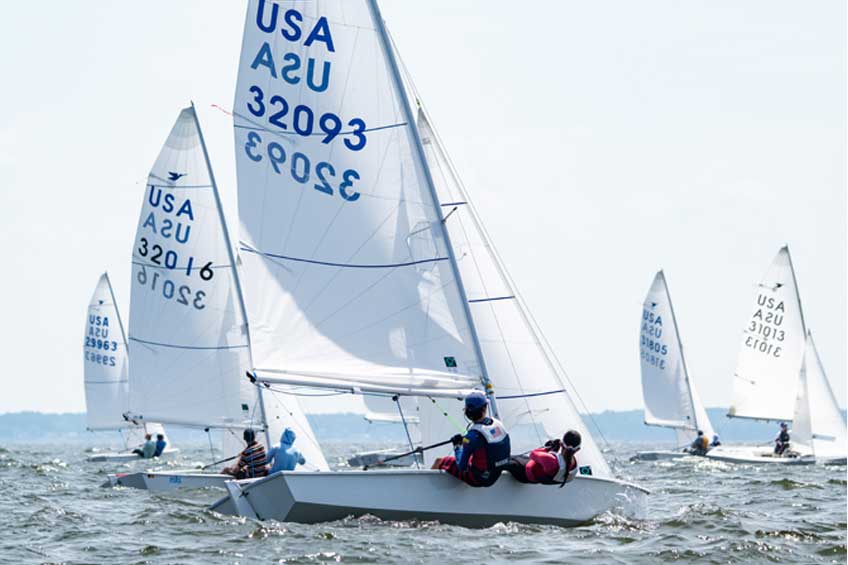 Quantum powered the winning team at the 2026 Snipe North American Championship and six of the top 10 boats overall, adding to strong showings at the U.S. Nationals and King of Spain Regatta earlier in the season.
For Quantum Sails, 2026 has been a year of putting those details under the microscope. From new sail technology and faster design iterations to class-specific refinements and more accessible tuning information, the Quantum One Design team has been using what it learns on the racecourse to continue evolving its products across a broad range of fleets.
"We do a lot of work with the reps and the design team together," says Quantum Sails One Design Director Scott Nixon. "After every event, we have a debrief with our reps in the class, sometimes our top customers, and the design team. We go over what we've tested, what worked well, what didn't. The open dialogue is what's pushing this forward."
Here's a closer look at some of the One Design developments emerging from that process in 2026.
Bringing VX Technology Into More One Design Sails
One of the most significant technology stories for Quantum's One Design program is the continued application of VX technology in classes that use membrane sails.
Quantum developed its new VX surface technology to create a smoother, more consistent foundation for membrane sails while improving durability. For One Design sailors, longevity is particularly important in classes that regulate the number of sails a team can purchase or use during a season.
"Technology-wise, the big thing for us in One Design, for the classes that get a membrane sail, is our new VX skins," Nixon says. "They're coming out really smooth, and they're more durable than the sails in the past."
The technology has applications across Grand Prix and One Design sailing and is already benefiting classes including the J/105, J/88, and J/111, where Nixon says updated VX surfaces are helping sailors get more life from their sails.
That matters because One Design sail development isn't solely about finding a faster shape for the next championship. A sail also has to hold that shape, remain consistent, and perform across the useful life expected by sailors in the class.
Faster Development From Screen to Sailboat
The tools behind the sails are evolving, too. For the Quantum design team, one of the biggest changes is how quickly a design can now move through the development cycle.
Quantum Sails North American One Design Director Travis Odenbach points to Sailpack Technology as an example. Once a sail design is in the program, designers can make changes digitally in seconds, rather than going through the much slower physical process of adjusting individual panels. "In the past, we had to hand-cut panels, move them, change them," Odenbach says. "Now we can do it there, put it on the 2D, go sail with it, test it and finesse it. It's so much faster, which means we can make those changes quickly and get that feedback immediately."
That speed matters in an increasingly iterative development process. A Quantum representative can identify something on the water, communicate it to the design team, test a change using 3D modeling software, implement it, and return to the racecourse with another iteration much faster than was possible in the past. The result isn't development for development's sake. It's the ability to respond more quickly when the team sees an opportunity to make a sail easier to use, more durable, or faster.
That process isn't limited to bigger keelboats. In the Snipe, Quantum draws on the experience of recognized class experts including George Szabo, Carter Cameron, and Alexandre Paradeda to keep the sail package moving forward. Newer designs, including the X-2 and XFB mainsails and RSJ-14 jib, build on previous generations, with changes aimed at different crew weights, wind ranges, and performance characteristics. The X-2 evolved from the X-1 with a smoother, more versatile shape, while the fuller XFB was developed with heavier teams in mind.
That development continues to show on the racecourse. Quantum powered the winning team at the 2026 Snipe North American Championship and six of the top 10 boats overall, adding to strong showings at the U.S. Nationals and King of Spain Regatta earlier in the season.
Refining the J/70 Sail Package
Few fleets provide a better laboratory for that process than the J/70. Quantum has put significant development resources into the class, with a particular focus on creating a sail package that is fast without being unnecessarily difficult to use.
"The J/70 sails have jumped unequivocally to a better design than we ever have had," Odenbach says. "Everything is becoming more streamlined. Everything can be used easily."
That balance is important. One Design development isn't necessarily successful if a sail is fast only within an extremely narrow setup window. The objective is to create a product sailors can understand, tune, and reproduce across changing conditions.
The J/70 also illustrates another reality of One Design development: "identical" boats aren't always identical. "It's One Design, but each mast and each boat is a little bit different," Nixon says.
The J/70 fleet, for example, includes two spar options, creating an additional variable for the design team to consider. Quantum develops and validates its sail package across both configurations, refining details such as luff curve and sail shape to deliver consistent, repeatable performance throughout the fleet. It is a level of precision that can be easy to overlook from the outside, but those details add up quickly in a competitive class.
Development Across Generations of One Design
That same process looks different in every class. In the Star, one of sailing's most established and technically demanding One Design classes, development is about continuing to refine an already deep body of knowledge. Quantum's current range includes various mainsail and jib combinations tailored to conditions, crew needs, and setup. The 46 mainsail and P-16 jib remain a versatile combination, while newer evolutions like the 59 and 60 mainsails provide different profiles and options across the wind range.
It's an approach backed by continued results. Quantum-powered teams took nine of the top ten places at the 2026 King of Spain and six of the top eight at the 2026 Baxter Bowl and 2nd in this year’s Star European Championships.
The Switch represents an entirely different development opportunity. Quantum has been involved with the modern singlehanded foiling class from the beginning as designer, developer, and exclusive sailmaker for the Switch sail package. The result is a sail developed specifically around the unusually broad performance demands of a foiling platform, from upwind control in heavy breeze to maintaining balance and control downwind in big chop.
The development doesn't stop once the sail is built, either. Working with sailors like Lukasz Machowski, the team continues to translate what is being learned on the water into practical setup and tuning guidance for the growing class.
Whether the platform has decades of accumulated knowledge or is helping bring a new generation of sailors into foiling, the underlying process remains the same: test, learn, refine, and share.
A Standout J/105 Jib
The same kind of targeted development is producing noticeable results in the J/105 class. Nixon points to Quantum's J/105 class jib as one sail that has gained significant traction.
"The one sail out there that's really popular is our J/105 class jib," he says. "People who switch into that sail end up having some really good success because the sail basically sheets in further than the other sailmakers' sails and they can sail higher. They've reaped the benefits really quickly." It's a useful example of what development looks like in a mature One Design class.
Innovation doesn't always mean introducing an entirely new technology or reinventing the wheel. Sometimes the meaningful advancement is identifying a specific performance opportunity within established class rules and refining the design around it.
The J/105 remains a major priority for Quantum alongside the J/88 and J/111, with continued development and the adoption of newer sail technologies helping the team refine products for established fleets.
Bringing Grand Prix Experience to the Cape 31
As one of the fastest-growing One Design classes in the world, the Cape 31 combines high-performance racing with a competitive and accessible fleet. Quantum has invested in developing a sail package that matches those demands, with designer Brett Jones spearheading the program.
The Cape 31 sail program draws on Quantum’s experience across the TP52, RC44, Melges, and other Grand Prix and One Design classes. That knowledge informs an ongoing process of testing and refinement focused on producing sails that are fast, consistent, and repeatable.
Development is supported by Quantum’s team in Hamble, England, giving sailors access to class expertise and hands-on service during regattas. It is another example of how Quantum combines high-level design experience with direct fleet support to keep both the sails and the sailors moving forward.
Continuing Development in the Melges 24
The Melges 24 is another established class receiving renewed attention in development. Here, the work extends beyond sail shape alone.
"We did a lot of design updates but also the sail detailing, the finish work, and updating as needed as we see things arise with different sails," Nixon says. "Making sure we're always pushing and working."
Odenbach similarly points to improvements in areas such as batten pockets, headboards, and other finishing details as examples of collaboration across Quantum's design and production teams. Those details might not generate the same attention as an entirely new sail, but they're part of making the finished product more consistent and refining what sailors receive from one sail to the next.
Supporting the Growing ClubSwan 28 Fleet
At the other end of the spectrum from established fleets like the Melges 24, Snipe, and Star is the relatively new ClubSwan 28. As the fleet grows internationally, Quantum has been putting significant resources into developing sails for the boat in both the United States and Europe, with Quantum designer Brett Jones among those involved in the project.
A developing class presents a different opportunity than a mature One Design fleet. Rather than optimizing within years or decades of accumulated knowledge, sailmakers, sailors, designers, and class leaders are learning about the boat at the same time.
That makes communication particularly valuable. Lessons from racing can quickly influence sail setup and tuning, which can then be shared with other sailors as the fleet expands. The ClubSwan 28 is also an example of Quantum applying experience from its Grand Prix programs to a One Design platform, taking tools and processes developed at the highest levels of the sport and making them useful within a growing fleet.
Making Tuning Information More Useful
Not every development happening in 2026 is something sailors need to buy. Quantum is also taking a closer look at how it delivers tuning information.
"We're learning there's so much information available that we put together some of the best tuning guides out there," Nixon says. "We're more open, and we share them with everyone. We want to share our data."
Odenbach says the team is working to simplify guides so sailors can more easily understand the baseline setup for their boat and sails. "We're sharing where we start our bases and how to look at the tracks and leads, so that when someone decides they want Quantum sails, they're not completely going in blind and feel comfortable."
The Snipe program is a good example of how Quantum continues to refine and organize class-specific tuning information. The goal is to give sailors clearer starting points and practical guidance for translating sail designs into repeatable settings on the water. More information isn't necessarily better information. The goal is to give sailors useful, accessible tools they can actually apply on the racecourse.
Small Changes, Compounding Gains
Taken together, many of the developments happening across Quantum's One Design program can sound small: a more durable membrane surface, a faster way to test a design change, a better-fitting luff curve, cleaner finishing details, a refined jib, or a tuning guide that gets a sailor to the right baseline sooner. But One Design racing is a game of small gains.
Each refinement solves a different problem, and each creates another opportunity to learn. The real development story is the speed at which those lessons can now move from the racecourse to the design team and back again.
The results across classes as different as the J/70, Snipe, Star, Melges 24, and J/105 are evidence of that process, while newer fleets like the Switch and ClubSwan 28 show how the same approach can be applied as classes grow and evolve. And increasingly, that development is starting before a new class even reaches the racecourse.
Developing the Next One Design Boats
The same development process Quantum is using to refine established One Design fleets is also starting earlier—sometimes before a new class has fully taken shape.
Nixon says the team is communicating with the development teams behind new boats, sharing information about boats and rigs as sail specifications are established. "Our team is working with boats and rigs and sharing data across manufacturers to make sure the first sets of sails they spec for their classes will be the right size," Nixon says.
That collaboration gives the sail design team an opportunity to understand a platform early, rather than waiting until a fleet is established to begin learning what it needs. It's also a fitting example of where One Design development is headed. There isn't one innovation defining One Design sailing in 2026. Instead, progress comes from the accumulation of improvements and the ability to identify, test, and share them faster.
From classes with generations of development behind them to boats that are only beginning to build their fleets, the process is remarkably similar: learn from the sailors, test on the water, refine the product, and put that knowledge back into the fleet.
That's what keeps One Design moving forward.