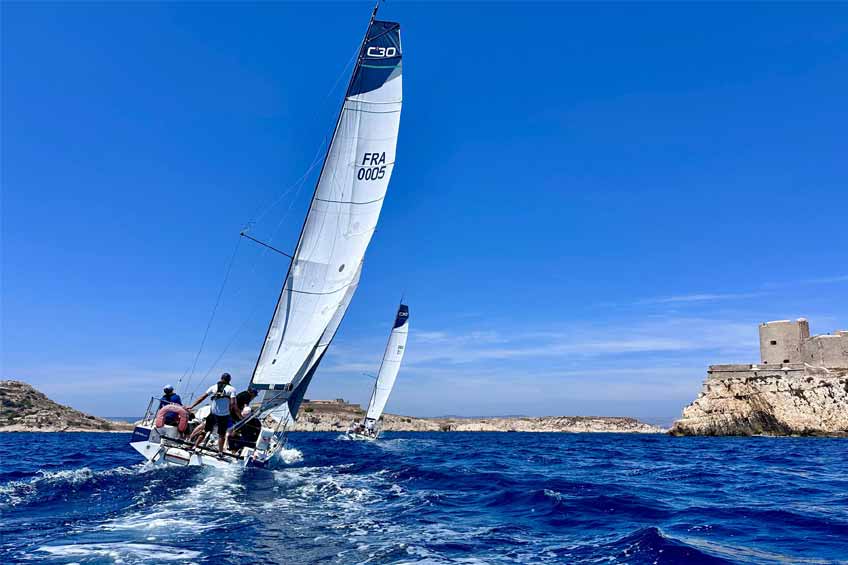
When the 2026 Offshore Double Handed World Championship begins in Marseille this September, two sailors on each boat will manage every maneuver, tactical decision, sail change, and hour of rest. Starting September 23, teams representing 15 nations across five continents will race supplied Sun Fast 30s out of Marseille. The championship is organized by the Cercle Nautique et Touristique du Lacydon in partnership with the Royal Ocean Racing Club, CAP Regatta and the Yacht Club de France, with support from the Fédération Française de Voile.
 Marie Cortial/CAP regatta
Quantum Sails has supported the fleet from the beginning, working with CAP Regatta and the boat's development team to create a sail package that can meet three competing demands. The sails must deliver the performance expected at a world championship, remain manageable for two-person crews and retain their shape through intensive use by successive teams. The collaboration shows how sail design, local service and long-term investment can help make elite offshore racing more accessible.
Why double-handed racing matters
Double-handed offshore racing compresses nearly every challenge of ocean sailing. One sailor may be resting while the other steers, trims, navigates and monitors the boat. A routine sail change for a full crew can become a major physical and tactical decision for two people, particularly at night or in rough conditions.
That changes the meaning of sail performance. A useful crossover range can remove an unnecessary change from the crew's workload. Predictable handling reduces time on the foredeck. Stable shape helps balance the boat when the autopilot is steering. Durability keeps those characteristics consistent after repeated offshore miles.
For Quantum, short-handed racing is a demanding development environment because speed cannot come at the expense of control or reliability. The same principles apply beyond this championship, whether sailors are racing overnight with a partner, making an offshore passage with a small crew or choosing an inventory that covers more conditions with fewer maneuvers.
A shared commitment to access
CAP Regatta Chairman Foad Zahedi came to the project with a complementary purpose. He credits the offshore racing he began as a young sailor with teaching lessons that later shaped his career. When he stepped away from the daily management of his maritime business, he wanted to give something back to the sport.
"I thought I was only sailing, but I didn't realize until much later that it was a school of life for me," Zahedi says. "Once I had achieved something, I felt I had to give back. This project was a way to believe in a small offshore boat and put young sailors on board."
 Marie Cortial/CAP regatta
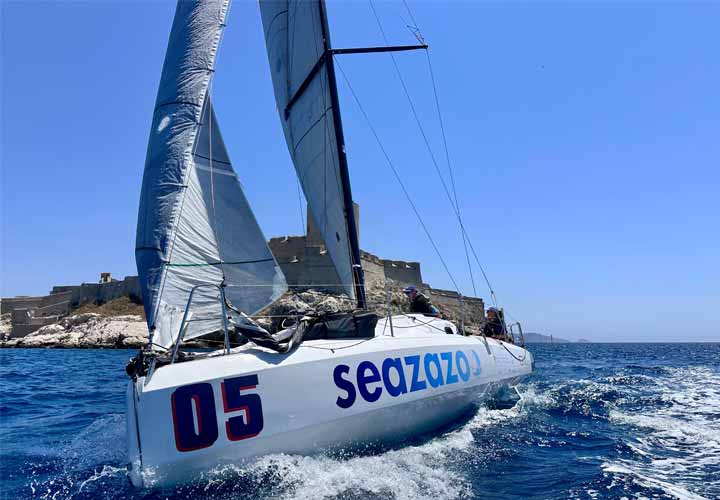
The supplied-boat model turns that aim into a practical opportunity. Teams can enter an international championship without first building and transporting individual campaigns around privately owned boats. A professionally managed fleet reduces certain equipment and logistical barriers while preserving the depth of offshore competition.
That purpose is closely aligned with Quantum's investment in the programs that help sailors progress through the sport. Supporting a fleet means providing more than sails for a single regatta. It means helping establish equipment, service, and technical knowledge that sailors can rely on as they gain experience and move toward more demanding campaigns.
Designing Equality Into the Inventory
Quantum France sail designer Adrien de Belloy says the first requirement was repeatability over time. For a charter fleet, the sails need to remain comparable after extensive use, not simply match when they leave production.
"First of all, the sails have to last. They will be used extensively by CAP Regatta, so repeatability is essential," de Belloy says. "Durtek has done excellent work building identical sails, and we relied on Contender to supply consistent rolls of cloth. The goal is the same sail from number one through number 22."
The standard reaches beyond common design files. Material consistency, cutting, assembly, and finishing all matter if no team begins with a meaningful equipment advantage. Once the sails enter service, they are handled by crews with different routines and approaches to sail care. Uneven stretch or distortion can eventually matter as much as a manufacturing difference. That operating reality drove the selection of Contender CDX sailcloth.
"Durability is the key, and outright performance comes second because this is a one-design fleet," de Belloy explains. "We needed a material that was durable and stable, one that would not distort as quickly as a conventional woven fabric but was rugged enough for several seasons and the hard use it may receive from successive teams. Contender CDX has worked very well so far."
Performance is therefore judged across the life of the fleet. A sail that is exceptionally fast on its first day would be the wrong solution if its shape changed faster than the sails around it. The right sail must preserve its profile and the integrity of the racing.
The Real Work of One Design
For CAP Regatta, maintaining parity turns every decision into a fleet-wide decision. Zahedi says the boats are kept within five kilograms of one another. The same attention applies to the sails and other equipment, where a small maintenance task or replacement must be considered across the full fleet.
"You can say a change is only one hour per boat, but one hour times 11 becomes two days of work," Zahedi says. "You have to remain at the same level for the athletes. They expect the boats to be equal."
That scale is one reason durability and local support matter. A sailmaker serving this type of fleet must understand the design intent, the history of each item in the inventory, and the operational consequences of any repair or replacement. Quantum France's proximity allowed de Belloy to meet with the project team throughout development and stay connected to the fleet as it entered service.
Zahedi says CAP Regatta considered several sailmakers, but chose Quantum because de Belloy understood the project immediately.
"Adrien was there from day one," Zahedi says. "We had other options, but he understood what we wanted to do. He was the first to understand the importance of the class and share the vision."
With the championship program extending into future seasons, CAP Regatta is also considering dedicated championship sails that can be stored between events, with separate inventories used for training and regular operations. The approach would preserve the competition sets and make it easier to equalize their conditions. It also illustrates why support for a supplied fleet requires a longer view than any one event.
Enough, But Not Too Much
The inventory had to balance two needs. The Sun Fast 30 One Design requires enough sail options to remain competitive across a wide range of conditions. Each additional sail, however, introduces another decision, maneuver, and layer of complexity for a double-handed crew. Quantum developed the package through repeated design discussions with Multiplast, which led the boat's development.
"I would prepare a design, return to the team with observations or questions, and then we would go through another design loop," de Belloy says. "The objective was a complete package that would last, keep the competition intense and give the boat enough sail area to stay properly powered, but without providing so many sails that the inventory stopped working for double-handed crews."
The sails were developed as a connected system. Each needed a clear role, a useful range and a logical place in the crew's decision-making. For two sailors, the best change is often the one they can postpone until conditions and fatigue make it sensible. Wider useful ranges allow crews to choose the timing of a maneuver rather than being forced into one when a sail suddenly becomes unmanageable.
Nailing the Start
A world championship generates valuable feedback, but fleet parity limits how quickly the designs can change. Replacing one sail on an individual race boat is straightforward. Updating a supplied fleet requires the organizer to make the same change across all teams or accept potential differences between teams.
 Marie Cortial/CAP regatta
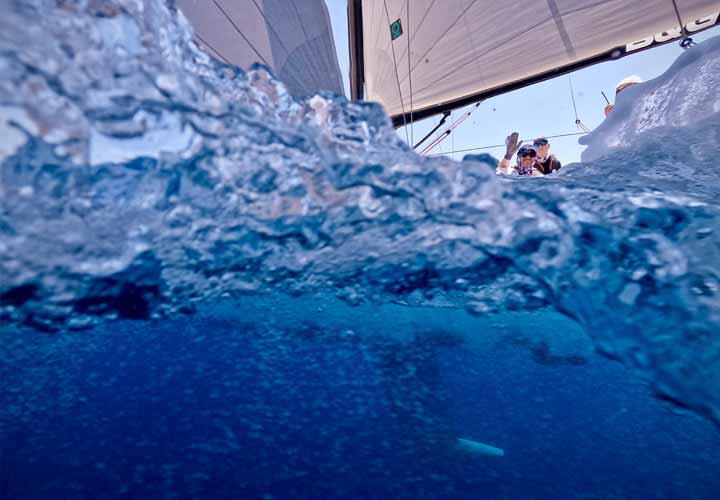
"The boat is highly specific, and so far we have not replaced many sails," de Belloy says. "We cannot simply replace one type of sail on a few boats to apply what we have learned from the teams' trimming techniques. Any meaningful change would have to preserve parity across the fleet. That puts even more emphasis on getting the first set right."
Few replacements are a positive measure of durability, but they also keep the original designs in service longer. More of the development work therefore has to happen before delivery. Quantum's early involvement with Multiplast and CAP Regatta made that front-loaded design process possible.
Building Bridges
Zahedi sees the fleet as a bridge between parts of the sport that have grown farther apart. Strong Corinthian sailors may struggle to find a next step beyond familiar local competition. At the same time, aspiring professionals face a large jump in cost and complexity before they can reach established offshore circuits.
"Thirty years ago, the Corinthian and professional worlds were connected. Today they have shifted apart, and there is no bridge between them," he says. "We want to be a smaller step that helps good sailors try something different and helps those who want a professional career move toward bigger boats."
The platform can also connect different sailing disciplines. Zahedi points to teams pairing experienced offshore sailors with younger athletes from Olympic programs. One brings offshore judgment and seamanship; the other may bring current knowledge from high-performance dinghy or Olympic campaigning. The supplied fleet gives them a place to combine those skills without first having to assemble a large professional program.
This is where Quantum's support extends beyond the technical demands of one sail package. Investment in one-design fleets, short-handed programs and the service behind them creates places for sailors to learn, compete and be seen. Some will remain committed amateurs. Others will move into Class40, IMOCA or other professional campaigns. A healthy pathway needs meaningful competition between those endpoints.
ODHWC 2026
Marseille can experience both light thermal conditions and the powerful Mistral. Double-handed teams will have to decide when to change gears, when to protect equipment, when one sailor can rest and when both are needed on deck: qualification races, a repechage and a winner-takes-all final add pressure to every one of those decisions.
The international field includes Olympic sailors, Ocean Race veterans, emerging offshore talent and sailors with extensive short-handed experience. Each team will begin with the same platform and a Quantum sail inventory designed to keep the emphasis where it belongs: on preparation, judgment and execution on the water.
For Quantum, the championship brings the partnership's larger purpose into focus. Thoughtful sail design and dependable service help CAP Regatta deliver fair racing now. Continued investment in fleets and development programs helps more sailors find their way into offshore sailing and a path forward in the sport.